
If you have been looking into treatments for thinning hair, microneedling has probably come up, often paired with exosomes. It is one of those treatments that sounds far more dramatic than it is, so here is a straightforward explanation of what it involves and what it can realistically do for your hair.
The Simple Version
Microneedling uses a device with very fine needles to create tiny, controlled channels in the scalp. Your body responds the way it responds to any small repair job, by sending blood flow and growth factors to the area. Around the hair follicles, that activity is exactly what you want.
There is a second benefit, and it is arguably the bigger one. Those tiny channels give anything applied afterwards a route below the surface of the skin. That is where exosomes come in. They are tiny vesicles that cells use to signal to one another, carrying growth factors and other messengers, and applying them to a freshly needled scalp means they can reach the follicles rather than sitting on top of the skin.
That is really the heart of it. Microneedling wakes up the scalp and opens the door, and the exosome solution goes through it.
Who Tends to Benefit Most
Microneedling suits people who are noticing thinning rather than those who have had bald areas for many years. If you can still see fine, wispy hairs in the thinning area, there are follicles there to work with, and that is a good sign.
It is a particularly sensible option if:
- your parting has widened or your hair feels less dense than it used to
- you are already using a topical treatment and want to get more from it
- you would rather start with something gradual before considering anything more involved
- you want to support the results of another treatment such as PRP
It is not the right starting point if your scalp is currently sore, flaky or inflamed, if you have a scalp infection, or if you have noticed smooth patches where the skin looks shiny and the follicle openings seem to have disappeared. Those need looking at properly first, and we would tell you so at consultation.
What a Session Actually Feels Like
Most people are surprised by how undramatic it is.
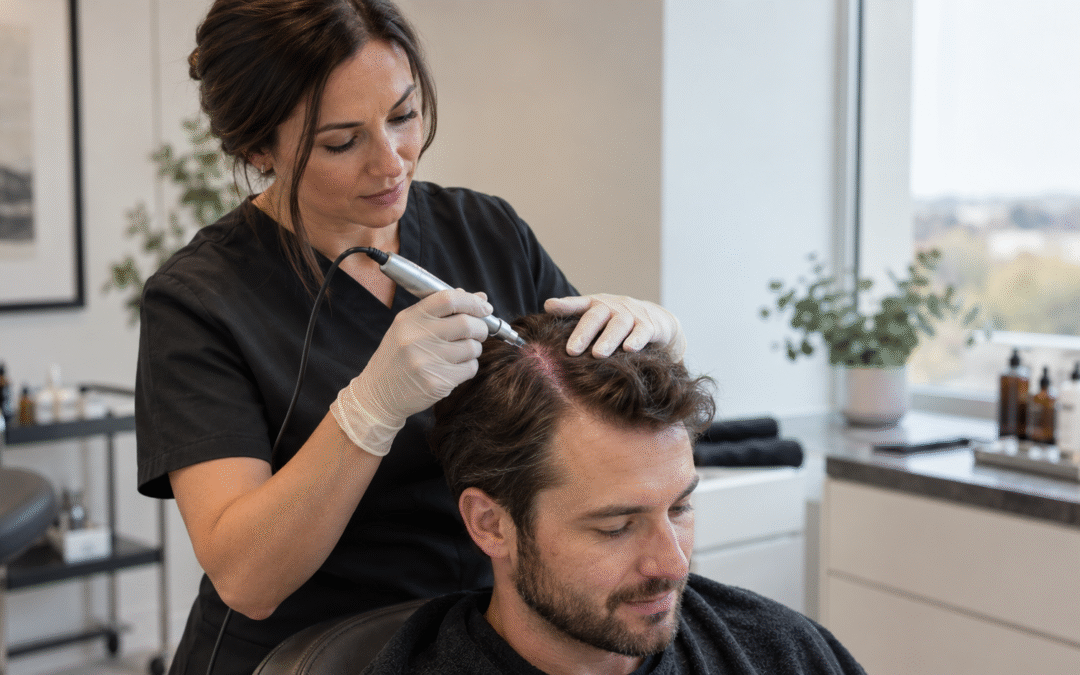
Your scalp is cleansed, and the treatment area is worked through section by section with a handheld pen device. The sensation is usually described as a light prickling or scratching, more odd than painful, and it is over in around half an hour. An exosome solution is then applied across the treated area, which takes only a few minutes more.
Afterwards your scalp will look a little pink and feel slightly tender, similar to mild sunburn. That generally settles within a day or so. You can go back to normal life straight away, though we would ask you to skip the gym, swimming and hot showers for the rest of the day, and to leave hair dye and styling products alone for a couple of days.
We will also give you a short window to wait before applying any topical treatment. Because the scalp is more absorbent immediately after needling, going straight back to your usual serum can sting more than usual.
Why In-Clinic Rather Than a Home Roller
Home dermarollers are inexpensive and easy to find, which is exactly why it is worth being careful.
Needling deliberately breaks the skin’s protective barrier, so hygiene genuinely matters. Home devices are difficult to sterilise properly and often used for months. Rollers also drag across the scalp rather than puncturing cleanly, and it is easy to press harder in the hope of better results, which tends to cause more damage rather than more growth. Published reviews of microneedling complications note reported issues including infection, pigment changes and scarring, with risks rising when the procedure is not carried out by a trained professional.
Scarring is the one to avoid, because a follicle lost to scarring does not come back. A treatment meant to improve your hair density should never be the reason it reduces.
In clinic, the device is sterile, the depth is set deliberately for your scalp, and someone is looking at the area properly before anything touches it.
How It Works With Everything Else
Microneedling is at its best as part of a plan rather than on its own.
With exosomes. At Hair Loss Studios, our scalp microneedling is paired with an exosome solution applied directly afterwards, so it travels through the freshly created microchannels rather than sitting on the surface. Exosomes are tiny vesicles that cells use to send signals to one another, carrying growth factors and other messengers. Applied to a freshly needled scalp, they are intended to support the environment around the follicles while the skin repairs. This is a newer area than some of the other options we offer, and while early findings are encouraging, the research is still developing. We would rather tell you that than overstate it.
With PRP. Microneedling also sits comfortably alongside PRP for hair loss, which uses growth factors drawn from your own blood.
With light therapy. Some people include LED hair therapy as part of a broader routine. You can see the full range on our hair loss treatments page.
It is also worth checking the basics before starting anything. Iron levels, thyroid function, recent illness, a stressful period or postpartum changes can all cause shedding, and sorting those out gives any treatment a much better chance.
When You Will See a Difference
Hair works on its own timetable, and it is a slow one.
A course of sessions is usually spread over several months. Three months is a fair point to take stock, and six months gives a much clearer picture. Some people notice a little extra shedding early on, which is unsettling but usually a sign that resting hairs are making way for new growth.
Because thinning is ongoing, maintenance sessions are generally part of the picture rather than a sign something has gone wrong. Results do vary from person to person, and we would rather set that expectation at the start than overpromise.
Frequently Asked Questions
Does microneedling help with hair growth? It can support thicker-looking hair by stimulating the scalp and by helping topical treatments reach the follicles more effectively. It works best alongside other treatments rather than on its own, and it suits thinning hair with active follicles better than long-standing bald areas. Results vary between individuals.
Does scalp microneedling hurt? Most people find it very manageable, describing a light prickling sensation rather than pain. Your scalp may feel tender and look slightly pink for a day afterwards. We will talk through comfort options at your consultation.
How many sessions will I need? That depends on how much thinning there is and what else you are using alongside it. Microneedling is generally done as a course spread over several months rather than as a one-off. We will give you a realistic plan once we have assessed your scalp.
Can I use a dermaroller at home instead? You can buy them easily, but the risks are higher than most people realise. Home devices are hard to sterilise, drag rather than puncture, and put depth and pressure in untrained hands. Infection, pigment changes and scarring have all been reported with microneedling, and scarring can permanently affect follicles.
Can I microneedle if my scalp is flaky or itchy? Not while it is active. Conditions such as psoriasis, eczema and seborrhoeic dermatitis need treating and settling first, because needling inflamed or broken skin can make things worse. Speak to your GP about the scalp condition, then come and see us about your hair.
What are exosomes, and how are they used in this treatment? Exosomes are tiny vesicles that cells release to communicate with one another, carrying growth factors and signalling molecules. In our scalp treatment, an exosome solution is applied to the surface of the scalp once the microchannels have been created by needling, so it can travel below the surface rather than sitting on top. It is applied topically rather than injected. We will explain exactly what we use at your consultation.
When can I wash my hair afterwards? We usually suggest leaving it until the following day, and using lukewarm water and a gentle shampoo when you do. We will give you full aftercare guidance on the day.
Book a Free Consultation
The most useful first step is finding out what is actually behind your hair loss, and whether microneedling is a good fit for it.
Book a free consultation at Hair Loss Studios in Bromley. We will assess your scalp and hair, talk through your history, and give you an honest view of your options. If we think something would suit you better, we will tell you.
Visit us at 14 Market Square, Bromley BR1 1NA, call 020 8290 0099 or book online.