
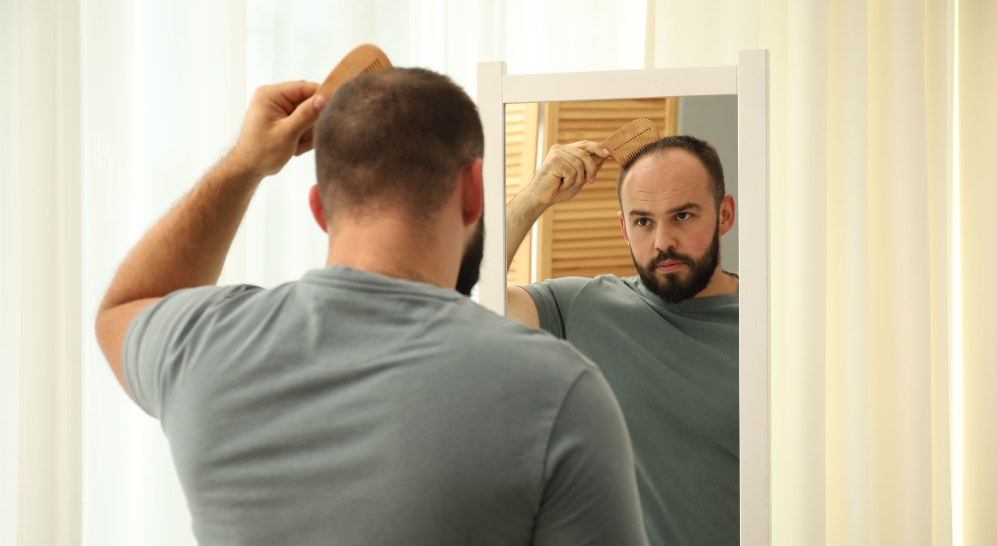
Male pattern baldness affects millions of men across the UK, yet it remains something many feel uncomfortable discussing. If you’ve noticed your hairline creeping back or a thinning patch appearing at your crown, you’re certainly not alone. Research shows that 40% of men have noticeable hair loss by age 35, rising to 65% by age 60 and 80% by age 80.
The good news? Understanding your hair loss is the first step towards doing something about it. At Hair Loss Studios in Bromley, we help men every day to understand their options and take control of their hair loss journey. This comprehensive guide explains exactly what male pattern baldness is, how it progresses, what causes it, and most importantly, what you can do about it.
What Is Male Pattern Baldness?
Male pattern baldness, medically known as androgenetic alopecia, is the most common form of hair loss in men. It accounts for approximately 95% of all male hair loss cases. Unlike other forms of hair loss that may be temporary or patchy, male pattern baldness follows a predictable pattern and, without treatment, is progressive.
The condition is characterised by a gradual thinning of hair, typically beginning at the temples and crown. Over time, the hairline recedes further and the crown patch expands until, in advanced cases, only a horseshoe-shaped band of hair remains around the sides and back of the head.
Male pattern baldness can begin at any age after puberty, though it most commonly starts in the late twenties or early thirties. Some men notice the first signs in their late teens, while others maintain a full head of hair well into middle age. The speed of progression also varies considerably – some men experience rapid hair loss over a few years, while for others, the process unfolds gradually over decades.
The Norwood Scale: Understanding the Stages of Male Pattern Baldness
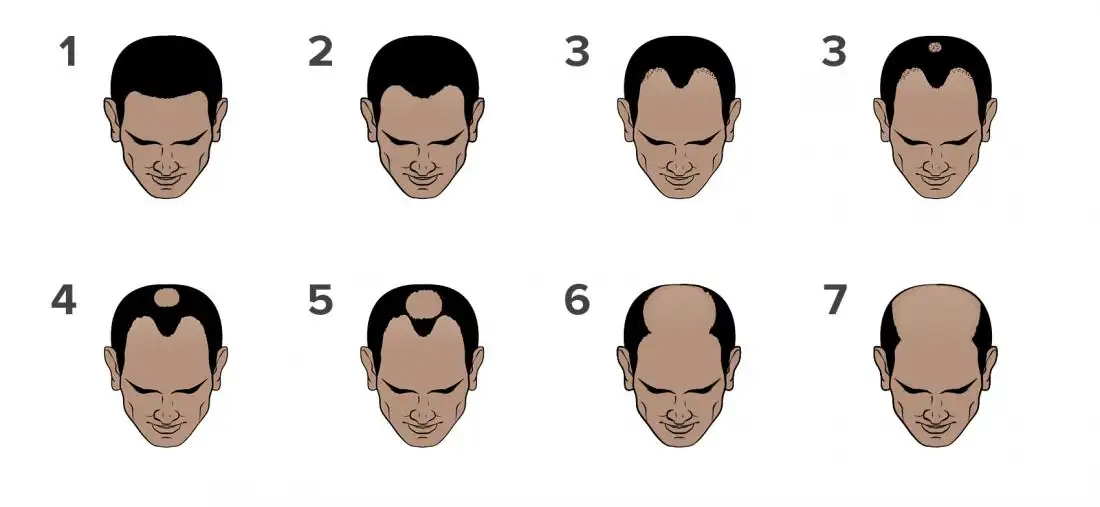
The Norwood-Hamilton Scale is the standard classification system used worldwide to measure and describe the stages of male pattern baldness. Developed by Dr James Hamilton in the 1950s and refined by Dr O’Tar Norwood in the 1970s, it provides a clear framework for understanding how hair loss typically progresses.
The scale ranges from Stage 1 (no significant hair loss) to Stage 7 (the most advanced stage). Understanding where you are on this scale helps determine the most appropriate treatment options.
Stage 1: No Significant Hair Loss
At this stage, there’s no noticeable hair loss or recession of the hairline. The hairline sits where it did in adolescence, and hair density appears normal across the scalp. Most men in their teens and early twenties fall into this category.
What to do: If you have a family history of baldness, this is an excellent time to establish good scalp health habits and consider preventative measures. No active treatment is typically needed.
Stage 2: Slight Recession at the Temples
Stage 2 marks the beginning of visible changes. The hairline starts to recede slightly around the temples, creating a subtle M-shape. This is often described as a “mature hairline” and is considered normal adult hair development rather than true balding.
However, if recession continues or you notice miniaturisation (hairs becoming finer and shorter), this may indicate the early stages of pattern baldness.
What to do: This is an ideal time for early intervention if you’re concerned. Treatments like minoxidil or PRP therapy can be highly effective at this stage, potentially halting progression before significant hair loss occurs.
Stage 3: The First Signs of Significant Balding
At Stage 3, hair loss becomes more pronounced. The temples recede further, creating a clear M, U, or V-shaped hairline. This is typically the first stage that’s classified as clinical baldness.
Stage 3 Vertex is a variation where the hairline remains relatively stable, but noticeable thinning or a bald patch develops at the crown (vertex) of the head.
What to do: Treatment is strongly recommended at this stage. Both medical treatments (minoxidil, finasteride) and regenerative therapies like PRP can produce excellent results. Some men may also be candidates for hair transplantation.
Stage 4: Significant Hair Loss
Stage 4 involves more substantial hair loss. The recession at the hairline deepens significantly, and the bald patch at the crown expands. However, a distinct band of hair still separates the front hairline from the crown.
What to do: A combination approach often works best at this stage – medical treatments to slow further loss combined with regenerative therapies to stimulate regrowth. Hair transplantation becomes a more viable option for restoration.
Stage 5: The Bridge Begins to Thin
At Stage 5, the band of hair separating the front and crown becomes noticeably thinner and narrower. The two areas of hair loss are beginning to merge, though some separation remains.
What to do: Treatment focus shifts towards maintaining remaining hair while considering restoration options. Hair transplantation can provide significant improvement, though realistic expectations about coverage are important.
Stage 6: Connecting Hair Loss
By Stage 6, the bald areas at the front and crown have essentially merged. Only sparse, fine hair may remain in the area that previously separated them. A horseshoe pattern of hair around the sides and back becomes more apparent.
What to do: Hair transplantation remains an option, though the goals become about creating the appearance of coverage rather than full restoration. Careful donor hair management is essential. Some men at this stage choose to embrace baldness completely.
Stage 7: The Most Advanced Stage
Stage 7 represents the most severe form of male pattern baldness. Only a thin band of hair remains around the sides and back of the head, forming the classic horseshoe pattern. The remaining hair is often fine and less dense.
What to do: Treatment options are more limited at this stage. Hair transplantation is still possible but requires careful assessment of donor hair availability. Many men at Stage 7 opt for a clean-shaven look, which can be very distinguished.
What Causes Male Pattern Baldness?
Understanding the causes of male pattern baldness helps explain why it affects some men more severely than others and why certain treatments work.
Genetics: The Primary Factor
Male pattern baldness is fundamentally a genetic condition. If your father, grandfather, or uncles experienced significant hair loss, you’re more likely to as well. The condition involves multiple genes, with the androgen receptor gene on the X chromosome (inherited from your mother) playing a particularly significant role.
This explains why many men observe similar hair loss patterns to their maternal grandfathers. However, genes from both parents contribute, so your father’s side matters too.
DHT: The Hormone Connection
The primary mechanism behind male pattern baldness involves dihydrotestosterone (DHT), a hormone derived from testosterone. DHT is produced when the enzyme 5-alpha reductase converts testosterone.
In men genetically predisposed to pattern baldness, hair follicles in certain areas of the scalp are sensitive to DHT. When DHT binds to receptors in these follicles, it triggers a process called follicular miniaturisation:
- The growth (anagen) phase of the hair cycle shortens
- Hair follicles gradually shrink
- Hairs become progressively finer, shorter, and lighter in colour
- Eventually, follicles stop producing visible hair altogether
Importantly, the follicles around the sides and back of the head are typically resistant to DHT, which is why these areas retain hair even in advanced baldness – and why they serve as donor areas for hair transplants.
Age
While male pattern baldness can begin at any age after puberty, the likelihood increases with age. This reflects the cumulative effect of DHT exposure over time on genetically susceptible follicles.
Other Contributing Factors
While genetics and hormones are the primary drivers, several factors can influence the onset, speed, or severity of hair loss:
- Stress: Significant physical or emotional stress can trigger temporary hair shedding (telogen effluvium) and may accelerate pattern baldness in some men
- Nutrition: Deficiencies in iron, vitamin D, zinc, and other nutrients can contribute to hair thinning
- Smoking: Research suggests smokers may experience earlier onset and more severe hair loss
- Medical conditions: Thyroid disorders, autoimmune conditions, and certain medications can affect hair growth
- Lifestyle factors: Poor sleep, chronic stress, and unhealthy diet may contribute to overall hair health
Treatment Options for Male Pattern Baldness
The earlier you address hair loss, the more options you have and the better the potential outcomes. Here are the main treatment approaches available.
PRP (Platelet-Rich Plasma) Therapy
PRP therapy has emerged as one of the most effective treatments for male pattern baldness, particularly for men who prefer a natural approach or want to avoid daily medications.
How it works: A small amount of your blood is drawn and processed to concentrate the platelets and growth factors. This platelet-rich plasma is then injected into the scalp, where the growth factors stimulate hair follicles, improve blood supply, and encourage thicker, healthier hair growth.
Why men choose PRP:
- Completely natural – uses your body’s own healing mechanisms
- No synthetic drugs or daily medications
- No risk of sexual side effects associated with finasteride
- Can be combined with other treatments for enhanced results
- Results typically visible from 3-6 months
At Hair Loss Studios, we recommend a course of 6-8 PRP sessions for optimal results, with maintenance treatments to sustain improvements. PRP is particularly effective for men in the early to moderate stages of hair loss (Norwood 2-5).
Minoxidil
Minoxidil (commonly sold as Regaine) is a topical treatment applied directly to the scalp. It works by increasing blood flow to hair follicles and prolonging the growth phase of the hair cycle.
Pros: Available over the counter, proven effectiveness, relatively affordable Cons: Requires daily application indefinitely, results reverse if stopped, can cause scalp irritation
Finasteride
Finasteride is an oral prescription medication that blocks the conversion of testosterone to DHT, addressing the hormonal cause of hair loss.
Pros: Highly effective at stopping hair loss, can promote regrowth, once-daily tablet Cons: Requires prescription, potential sexual side effects (affecting a minority of users), must be taken indefinitely
LED Light Therapy
LED light therapy uses specific wavelengths of red light to stimulate cellular activity in hair follicles. It’s painless, has no side effects, and can enhance results from other treatments.
Hair Transplantation
For men with more advanced hair loss who want permanent restoration, hair transplantation remains an option. Modern techniques like FUE (Follicular Unit Extraction) produce natural-looking results by transplanting individual follicles from the donor area (back and sides) to balding areas.
Hair transplants work best when:
- You have sufficient donor hair
- Your hair loss has stabilised
- You have realistic expectations about coverage
We work with trusted surgical partners in London and can provide referrals for men who are suitable candidates.
Combination Approaches
For many men, the best results come from combining treatments. Common combinations include:
- PRP therapy + minoxidil
- PRP therapy + LED light therapy
- Finasteride + minoxidil + PRP
At your consultation, we’ll recommend the approach most likely to achieve your goals based on your stage of hair loss, health, lifestyle, and preferences.
When Should You Seek Treatment?
The simple answer is: the earlier, the better. Hair loss treatments are most effective when started before significant follicle miniaturisation has occurred. Once follicles have completely stopped producing hair, regenerating them becomes much more difficult.
Signs it’s time to take action:
- Your hairline has noticeably receded
- You can see more scalp through your hair than before
- The parting in your hair appears wider
- You’re finding more hair in the shower, on your pillow, or in your brush
- Family members or friends have commented on thinning
Many men delay seeking help because they feel embarrassed or assume nothing can be done. In reality, modern treatments can produce significant improvements, particularly when started early.
What to Expect at a Hair Loss Consultation
At Hair Loss Studios, we offer free, no-obligation consultations for men concerned about hair loss. During your consultation, we’ll:
- Discuss your hair loss history and any family patterns
- Assess your current hair loss using the Norwood scale
- Examine your scalp health and hair quality
- Discuss potential underlying factors (stress, nutrition, health conditions)
- Recommend whether blood tests might be helpful
- Explain all suitable treatment options honestly
- Provide clear information about costs, timelines, and realistic expectations
We believe in straightforward advice with no pressure. Our goal is to give you the information you need to make the right decision for you – whether that’s active treatment, preventative measures, or simply monitoring your hair loss over time.
Ready to Take Control of Your Hair Loss?
Book a free, no-obligation consultation at Hair Loss Studios Bromley. We’ll assess your hair, explain your options, and help you choose the right approach.
Call us: 020 8290 0099
Frequently Asked Questions
Can male pattern baldness be reversed?
Early-stage hair loss can often be slowed, stopped, or partially reversed with treatments like PRP therapy, minoxidil, or finasteride. However, once follicles have been dormant for an extended period, regenerating them becomes more difficult. This is why early treatment is so important.
At what age does male pattern baldness start?
It can begin at any age after puberty. Around 25% of men show signs of hair loss by age 25, and 40% have noticeable hair loss by age 35. However, some men don’t experience significant hair loss until their 50s or 60s.
Is male pattern baldness inherited from your mother or father?
Both sides of the family contribute. However, the androgen receptor gene on the X chromosome (inherited from your mother) plays a particularly significant role, which is why hair loss patterns often resemble those of maternal grandfathers.
Do hats cause baldness?
No. This is a common myth with no scientific basis. Wearing hats does not cause or accelerate male pattern baldness.
Can stress cause male pattern baldness?
Stress doesn’t cause androgenetic alopecia directly, but it can trigger temporary hair shedding (telogen effluvium) and may accelerate hair loss in men already predisposed to pattern baldness. Managing stress is beneficial for overall hair health.
What’s the best treatment for male pattern baldness?
There’s no single “best” treatment – it depends on your stage of hair loss, health, preferences, and goals. Many men achieve excellent results with PRP therapy, either alone or combined with other treatments. The best approach is tailored to your individual situation, which is why we recommend a consultation.
Is PRP better than minoxidil for hair loss?
Both are effective but work differently. Minoxidil is a daily topical medication applied at home, while PRP is an in-clinic treatment using your body’s own growth factors. Many men prefer PRP because it’s natural, requires no daily routine, and has no risk of the side effects associated with medications. Some men use both together for enhanced results.
Sources
- Wimpole Clinic. “Hair Loss Statistics And Facts In The UK.” https://wimpoleclinic.com/blog/facts-and-statistics-about-hair-loss-in-the-uk/
- Chemist4U. “Hair Loss Statistics 2025 – Facts and Stats Report.” https://www.chemist-4-u.com/guides/hair/hair-loss-statistics/
- Treatment Rooms London. “Hair Loss in the UK: Facts & Statistics.” https://www.treatmentroomslondon.com/hair-loss/uk-hair-loss-facts-statistics/
- Rhodes T, et al. “Prevalence of male pattern hair loss in 18-49 year old men.” Dermatologic Surgery. 1998. https://pubmed.ncbi.nlm.nih.gov/9865198/
- Ho CH, Sood T, Zito PM. “Androgenetic Alopecia.” StatPearls/NCBI Bookshelf. 2023. https://www.ncbi.nlm.nih.gov/books/NBK278957/
- Gupta AK, et al. “Classification of Male-pattern Hair Loss.” International Journal of Trichology. 2016. https://pmc.ncbi.nlm.nih.gov/articles/PMC5596658/
- Healthline. “Norwood Scale: Pictures, Stages, Causes, and Treatment.” https://www.healthline.com/health/norwood-scale
- Aventus Clinic. “Hair Loss in the UK – A Statistical Deep Dive.” https://aventusclinic.com/hair-loss-in-the-uk-stats/